
APR 25, 2026
My Bible reading this morning included the words of Jesus in Luke 17: 26-37,
“Just as it was in the days of Noah, so also it will be in the days of the Son of Man: People were eating and drinking, marrying and being given in marriage, up to the day Noah entered the ark. Then the flood came and destroyed them all.
“It was the same in the days of Lot: People were eating and drinking, buying and selling, planting and building. But on the day Lot left Sodom, fire and sulfur rained down from heaven and destroyed them all.
“It will be just like that on the day the Son of Man is revealed.
“On that day, let no one on the housetop come down to retrieve his possessions. Likewise, let no one in the field return for anything he has left behind.
“Remember Lot’s wife!
“Whoever tries to save his life will lose it, but whoever loses his life will preserve it.
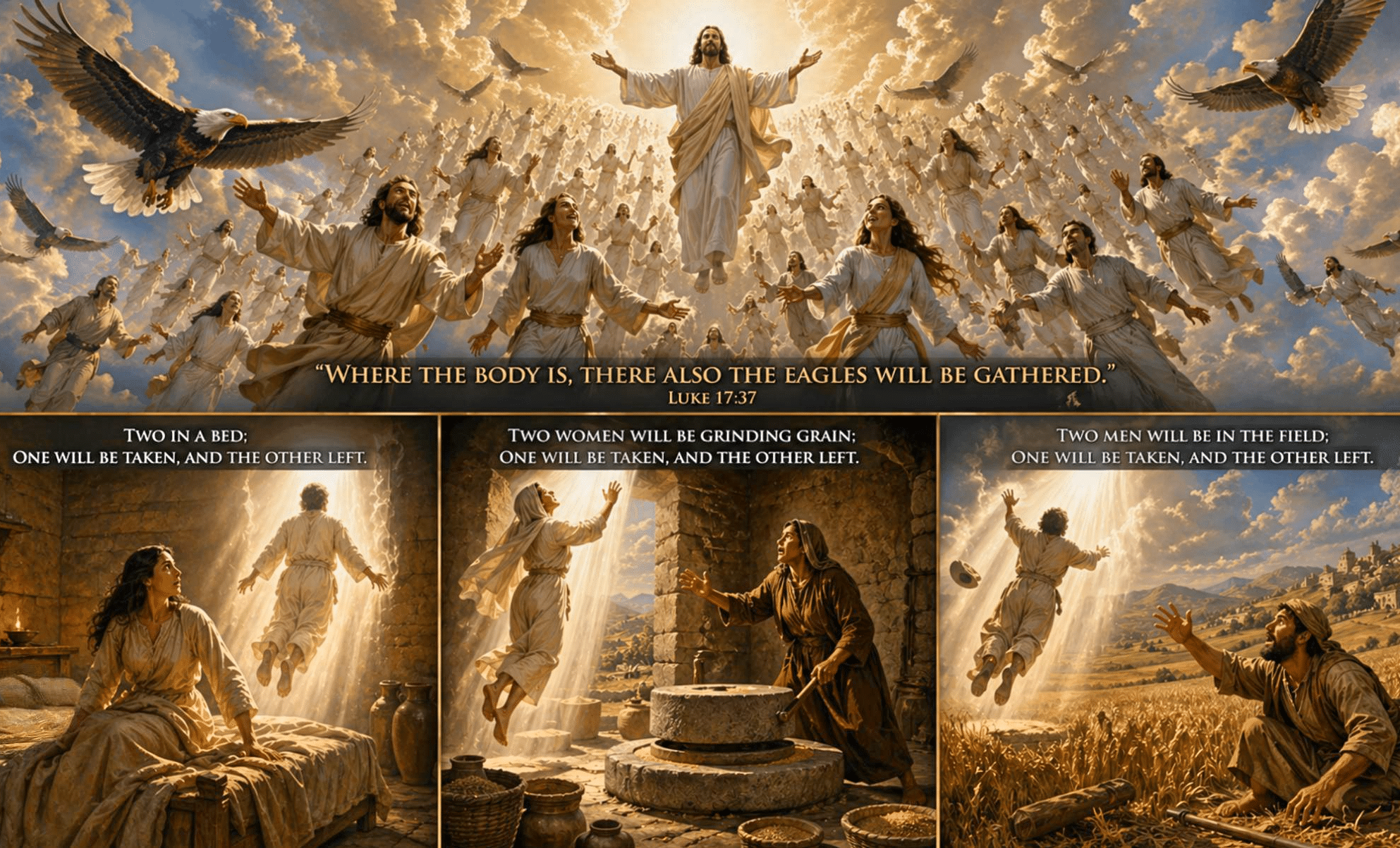
“I tell you, on that night two will be in bed; one will be taken and the other will be left.
“Two women will be grinding grain; one will be taken and the other left.
“Two men will be in the field; one will be taken and the other left.
“And they said, ‘Where, Lord?’
“And He answered, ‘Where the body is, there also the eagles will be gathered.’” -Luke 17: 26-37
Some commentators both ancient and modern have interpreted “the body” to mean Messiah, and “the eagles” to be his gathering saints (born-again believers) in the Rapture.
And that is exactly what I envisioned when I read the passage this morning.
It came to me as fresh revelation.
It’s deeply meaningful when a passage “lights up.”
Eagles gathering around a body—this strange parable previously had been a mystery but seemed clear this morning.
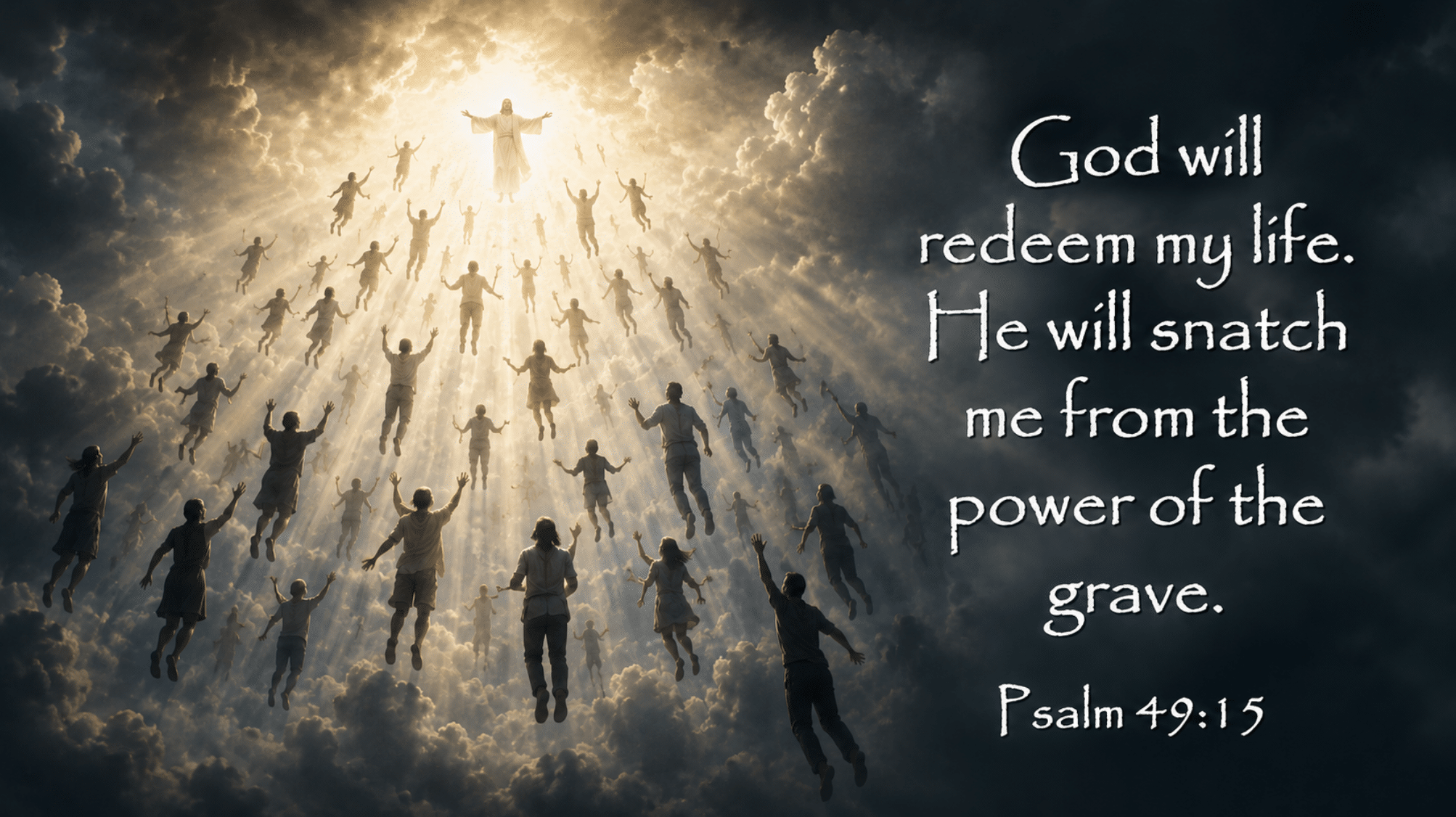
And so I asked ChatGPT to generate a picture of what I saw in Luke 17.
This interpretation–the body as Messiah and the eagles as His gathered saints in the Rapture.
The Gospel writer Luke specifically used the word sōma (”body,” which can imply a living body) rather than Matthew’s ptōma (meaning “corpse”).
This allows for seeing this picture as Jesus drawing believers to Himself.
I checked various Bible commentaries and indeed certain early and later commentators including a classic expositor like Matthew Poole linked the eagles to saints with “eagle eyes” of faith, gathering to the returning Lord. This interpretation also evokes biblical imagery like eagles’ wings carrying God’s people (Exodus 19:4; Isaiah 40:31) or the elect being gathered (Matthew 24:31).
At the same time, the historical and contextual reading also sees these verses as judgment imagery: vultures/eagles (aetoi) inevitably gathering over a body signals the sudden, visible, and inescapable nature of divine judgment on the unprepared (echoing Noah and Lot).
The “taken” ones are sometimes understood as those removed in judgment, while the righteous are “left” to enter the kingdom.
I would suggest a balanced takeaway. Scripture often works on multiple levels—literal, symbolic, immediate application, and future hope.
My personal insight highlights the gathering aspect at the Lord’s return, which is beautiful and is echoed elsewhere in the Bible (e.g., 1 Thessalonians 4:17; Matthew 24:31).
According to the Pulpit Commentary, the Lord’s answer to the question – “Where?” applies to the whole earth. Please note that the scenes of separation will take place everywhere and in various time zones—some are sleeping at nighttime; others are working during the day.
The Pulpit Commentary acknowledges that “many great expositors favour” the interpretation of the body being the body of Christ, and the eagles are his saints, flocking to his presence, feeding upon him, especially in the act of Holy Communion.
However you interpret these passages, believers are ultimately drawn to Him.
According to the Geneva Study Bible, “The only way to continue is to cleave to Christ.”
The key exhortation in the whole passage remains urgent regardless of the exact symbolism:
Be ready.
Live faithfully.
Don’t be caught unaware like those in Noah’s or Lot’s day.
If this interpretation is strengthening your walk with God, that’s the real fruit.
I’d encourage continuing to pray through, compare parallel passages, and read a few solid commentaries.
To summarize, common interpretations include:
Obviousness: Just as vultures inevitably spot and gather at a carcass, the signs of Jesus’ return (or judgment) will be unmistakable and impossible to miss—like lightning flashing across the sky.
Judgment imagery: It evokes scenes of sudden destruction, where the wicked are “left” and face doom (comparable to the days of Noah or Lot), with carrion birds symbolizing inevitable consequences. Some linked it to Roman armies (eagles on standards) destroying Jerusalem.
Gathering of the faithful: points to believers drawn to Messiah (the “body”) like birds to sustenance.
To contact Christine Darg, or to support her work, visit JerusalemChannel.tv


Is the Rapture piece Christine Darg showed in her show available for purchase?