
Lebanese Christians Thank Israel and Ask for Protection
Christine Darg comments on yesterday’s “one-day war”
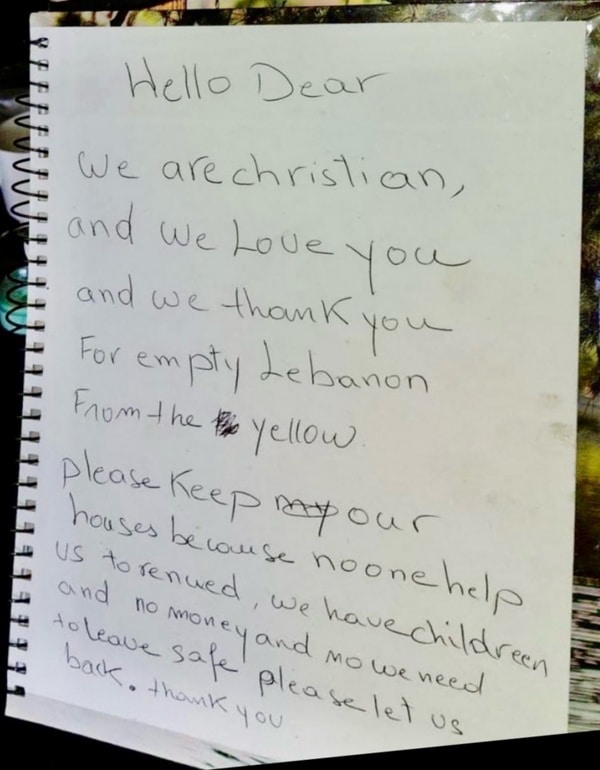
This photo of a hand-written note for IDF soldiers inside a Lebanese home is making the rounds of social media, and indeed it speaks volumes.
This handwritten note was left for soldiers of the IDF’s 9260th Battalion by a Lebanese Christian family:
“We are Christians, we love you, and we thank you for emptying Lebanon of yellow [Hezbollah]. Please protect our homes. No one is helping us rebuild. We have children, no money, and we need to return safely.”
This is indeed a remarkable message of reality from inside Lebanon, revealing what civilians face who are living under Hezbollah’s shadow.
Hezbollah is referred to as “yellow” by Christian Lebanese because of its official flag, which features Arabic text and a rifle against a bright yellow background. [1, 2]
In the highly polarized and sectarian Lebanese political landscape, calling the group “yellow” (and by extension referring to its strongholds or affiliates as “the yellows”) is frequently used as a pejorative. Christian critics, who broadly oppose the group’s unchecked military power and its ties to Iran, use the term to distance themselves from the organization.

[Above screenshot: The Telegraph] Meanwhile, many Israelis and Arab Israelis are expressing dismay to me that yesterday’s “one-day war” was not followed by great military action on the part of the USA and Israel.
One thing I can say is that the Bible indicates in Ezekiel 38: 5 that an invasion of the mountains of Israel in the Last Days will include the unrepentant leadership of Persia (modern-day Iran) and it will be God Almighty who defeats them at that time—NOT President Trump nor Bibi Netanyahu. God Himself.
Therefore behind the scenes the hand of God could be restraining the lack of action at this very moment. Or Trump could yet be planning some sort of surprise.

Yesterday morning a siren went off and our son ran to the rooftop of our ministry center to capture this interception of an Iranian missile over Jerusalem’s Tower of David. Directly above the interception, the moon is the tiny dot.
Historically, Jerusalem was rarely a direct target because past conflicts—such as wars with Hamas in Gaza or Hezbollah in Lebanon—were primarily fought using short-range rockets. Those groups strategically targeted border towns and central coastal areas, and Jerusalem remained largely out of their standard range.
However, since the October 7, 2023 atrocities, the nature of the conflict has fundamentally shifted.
Unlike past proxy conflicts, the wars have escalated into direct military exchanges between Israel and Iran.
Iran launched massive, coordinated barrages of long-range ballistic missiles and drones from its own territory targeting Israel.
Because Iranian ballistic missiles (such as the Emad or Fattah) are highly advanced, long-range weapons are designed to strike high-value military assets, government headquarters, and major population centers rather than border towns.
As Israel’s capital and largest city, Jerusalem houses critical national infrastructure and symbols of state, making it a primary target in these direct state-on-state engagements.
Even when Israel’s multi-layered air defense systems (including the Arrow and Iron Dome) successfully intercept incoming Iranian missiles, the resulting impact of shattered debris, unburned fuel, and falling shrapnel frequently falls into the city. In fact, during direct strikes from Iran, debris from interceptions has crashed into unpopulated areas, open spaces, and even historical and religious sites within the Old City such as the Church of the Holy Sepulchre.
If an Iranian missile damages or destroys properties on the Temple Mount no doubt Israel would be blamed.
To contact Christine Darg, visit www.JerusalemChannel.tv and please sign up for our weekly email alert.
To watch Christine’s latest video visit the website or our YouTube platform:


Leave A Comment