
By Christine Darg
CD Christian Zionism
President Donald Trump’s Christianity is best understood as nominal and deeply pragmatic rather than devotional or theological.
He rarely attends church, in the past has admitted he does not ask God for forgiveness, and doesn’t know how to quote Scripture.
His personal conduct—frequent profanity, boasting, divorces, admitted sexual indiscretions—places him far outside the behavioral norms traditionally expected of devout believers.
Yet his support from evangelicals is not rooted in the belief that Trump is a model Christian, but in the conviction that he is a useful “imperfect vessel” or modern-day Cyrus (the pagan Persian king whom God used to free the Jews).
For many Americans, Trump’s vulgarity and bravado are not disqualifiers; they are proof of authenticity in a culture they see as having been dominated by hypocritical, polished elites.
His willingness to swear, to mock political correctness, and to fight ruthlessly against abortion, LGBTQ rights, and secularism signals that he is on their side in a culture war.
To many evangelicals, apparently Trump’s action—appointing three Supreme Court justices who overturned Roe v. Wade, moving the U.S. embassy to Jerusalem, and championing “religious liberty” legislation—outweigh his lack of personal piety.
During his first term, President Trump took specific actions at the United Nations to highlight and address the persecution of Christians and other religious minorities. Trump hosted the “Global Call to Protect Religious Freedom.” This was the first-ever UN event hosted by a U.S. president that was entirely dedicated to the issue of global religious freedom, with a particular emphasis on persecuted Christians, Yazidis, and other religious minorities. More recently he has stood up like a lion on behalf of Nigeria’s persecuted Christians.
In short, Trump practices a transactional, results-oriented Christianity: he delivers political and judicial wins for the movement, and in exchange, evangelicals somehow grant him absolution for his profanity. Furthermore, his ego and pride are not seen as sins that disqualify him, but as rough edges on a warrior doing God’s bidding in a fallen world.
This perception reveals a profound shift in American evangelicalism: from an earlier era that demanded personal morality in leaders to a pragmatic posture that somehow justifies or overlooks un-Christlike means.
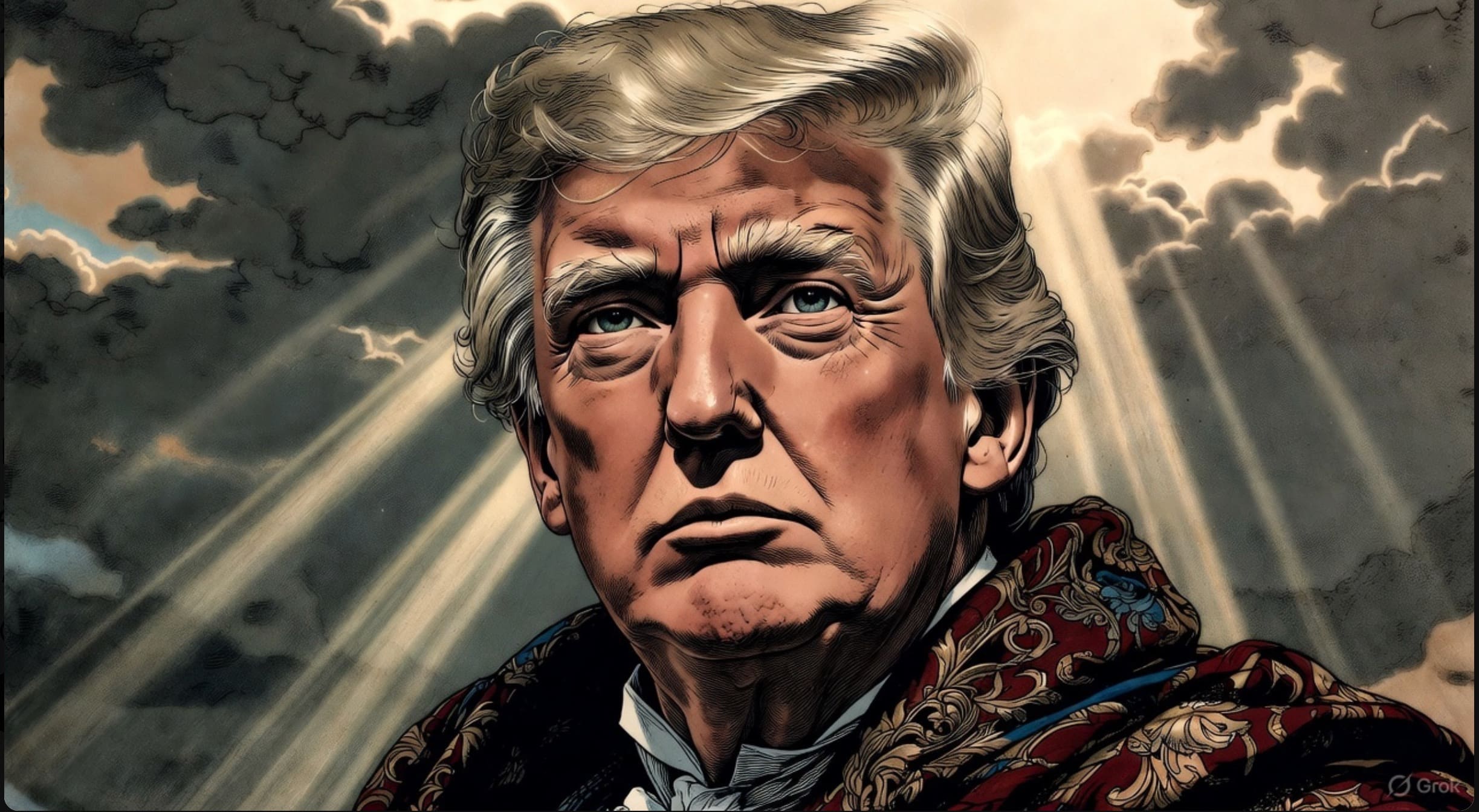
So I asked AI (Twitter’s— X’s Grok) to give me some potential titles for this article, and it came up with these originals capturing the tension between Trump’s public Christian advocacy and his unfiltered, profane style:
- “Golden Calves and Golden Tongues: Trump’s Very Earthly Christianity”
- “Swear to God: How Trump Made Profanity Part of the Christian Right’s Brand”
- “Sinner, Savior, Showman: The Unapologetic Faith of Donald Trump”
- “Blessed Are the Crude: Trump and the Theology of ‘Authenticity’”
- “From the Penthouse to the Pulpit: Trump’s Transactional Christianity”
- “Grab ’Em by the Psalms: Why Evangelicals Love Their Imperfect Vessel”
- “Holy Ghostwriter: When Trump Speaks Like a Sinner but Prays Like a Saint”
- “Two Corinthians and a Lot of F-Bombs: Trump’s Nominal Christianity”
- “The Art of the Deal with God: Trump’s Pragmatic Faith”
- “Render Unto Caesar What Is Caesar’s—and a Few Curse Words Too”
In this post I’d like to approach this subject to keep things balanced, biblical, and focused on explanation rather than debate.
Hopefully I want to explain concepts of nominal Christianity.
Here’s the problem that’s so hard to iron out in people’s minds: Many, even professing Christians, utterly hate and despise Donald Trump and can’t believe he’s a Christian because of his uncouth tongue. Truly his behaviour is not always “Christian,” yet he does “Christian” things like acting as a father to many, holding up a bible to the nation and even printing Bibles.
Here’s some background on his upbringing: Donald Trump was raised in the Presbyterian Church in the U.S.A. (later PCUSA), attending First Presbyterian Church in Jamaica, Queens, where he was confirmed in 1959. His Scottish-born mother who emigrated from the Isle of Lewis in the Outer Hebrides, had been profoundly influenced by the intense 1949–1952 Hebrides Revival—a Pentecostal-style awakening led by Duncan Campbell that swept the Gaelic-speaking Presbyterian communities of her youth. She carried a deep, emotional faith to America. As a boy, Trump also regularly attended Norman Vincent Peale’s Marble Collegiate Church in Manhattan with his family. Peale, the bestselling author of “The Power of Positive Thinking” and the most prominent advocate of blending Christianity with optimism and success, officiated at Trump’s first wedding and remained a lifelong influence. In 1957, eleven-year-old Donald accompanied his mother to Billy Graham’s historic 16-week crusade at Madison Square Garden, an event that drew over two million and resonated strongly with Scottish Presbyterian revivalists living in New York.
Being President doesn’t mean a leader has to be a saint or a pastor, although sometimes Trump acts like a pastor because of his warm style of telephoning, writing to or even taking time to visit bereaved folks or disaster areas. There are countless reports of how he has secretly financed needy, desperate individuals.
Somewhere along the line Trump has had an epiphany about the nation’s need to return to God in order to maintain law and order. Perhaps he’s not born again in the biblical sense –only God knows– yet he could be a baby Christian or carnal Christian who needs to learn to control his tongue.
According to gotquestions.org, nominal Christianity is a concept that’s been around for centuries, referring to people who identify as Christian—perhaps culturally, socially, or even politically—but whose faith doesn’t deeply transform their daily life, beliefs, or behavior. It’s like having a membership card to a club without actively participating in its activities or embracing its core rules. Think of it as “Christian in name only” (from the Latin nomen, meaning “name”). This isn’t a judgment on anyone’s soul—that’s God’s territory—but a way to understand why someone’s actions might not always line up with traditional Christian ideals.
To help people grasp this, especially in tricky discussions about figures like Donald Trump, we need to show empathy: I do acknowledge concerns about “un-Christian” moments (e.g., profanity, harsh quips or past behaviors), while I must also point out that Christianity is not a perfection contest.
Let’s draw on biblical principles and incorporate Trump’s recent 2025 statements on faith to show an evolving public stance.
People often confuse cultural Christianity with deep, personal faith. Nominal Christians might go to church occasionally, celebrate holidays like Christmas, or support “Christian” causes, but their faith isn’t the driving force behind their decisions.
According to billgraham.org, signs of nominal faith are: no strong evidence of repentance, transformation, or a close relationship with God—like reading the Bible regularly or prioritizing prayer. Signs of nominal Christianity also include referring to God in vague terms, showing little fruit of the Spirit (like self-control mentioned in Galatians 5:22-23).
Imagine someone who wears a team’s jersey but never watches the games or follows the rules—they’re a fan “in name only.” That’s nominal Christianity– identifying as Christian without letting it change your heart or habits. Unfortunately it’s common in cultures where Christianity is the default religion.
Jesus warns in Matthew 7:21-23 that not everyone who calls Him Lord will enter heaven.
We should be grateful at least that President

Trump regularly makes statements like that above, and he advocates in his 2025 speeches, “To have a great nation, you have to have religion.” That shows support for Christian values on a national level, even if his personal walk isn’t picture-perfect.
Somehow I want to explain to complainers that Presidents don’t have to be saints—leadership is about action, not perfection.
In fact, the role of a president is to govern justly, protect freedoms, and promote law and order—not to be a moral exemplar like a pastor. Biblical kings like David (an adulterer and murderer) or Cyrus (a pagan Persian king praised in Isaiah 45 for helping God’s people) weren’t saints, but nevertheless God used them for good.
In modern terms, politics is messy; expecting flawlessness sets us up for disappointments.
Being president is a job focused on policy and protection, not personal holiness.
Think about this: Abraham Lincoln freed the slaves but had doubts about his faith. Jimmy Carter was deeply devout and a Sunday School teacher but had very flawed policies.
Trump holding up a Bible at St. John’s Church or pushing religious liberty policies shows he’s acting as a benevolent father figure for Christian causes, even if his words sometimes sting. The Bible says in Romans 13:1-4 that leaders are God’s servants for order and justice, not perfection. We can appreciate the good without excusing the flaws.
At least Trump doesn’t hide or deny his rough edges, but he IS trying to protect Christians from persecution. His leadership is prioritizing faith-based law and order, like his Religious Liberty Commission—even if he’s not quoting Scripture like a preacher.
When it comes to issues such as abortion and religious freedom, apparently the formerly liberal Donald Trump has become a conservative—he’s had a “lightbulb moment” to see faith’s value for society, even if it’s not fully personal yet.
An epiphany doesn’t have to be a dramatic conversion like the apostle Paul’s conversion on the Damascus road. It could be realizing that godly principles (like justice, morality, and order) are essential for a nation’s survival, as in Proverbs 14:34: “Righteousness exalts a nation, but sin is a reproach to any people.” This might start nominally but grow deeper.
Sometimes people have a wake-up call about faith without an immediate full “born-again” experience. For Trump, it seems like he’s had an epiphany that America needs to return to God to fix chaos—like crime, division, and moral decline. He’s said things like, ‘We’re bringing back religion in our country” because he believes faith makes nations strong.
So it’s not about him being a theologian; it’s about seeing God’s role in law and order. The Founding Fathers invoked divine Providence without all of them being saints or born-agains.
In 2025 interviews, Trump has talked about wanting to get to heaven and linking faith to America’s success, saying “for America to be a great nation, we must always be one nation under God.” To me that sounds like an epiphany focused on national renewal, even if his personal journey is ongoing.
To my delight, President Donald Trump has made several recent statements in 2025 emphasizing the critical role of PRAYER in restoring and strengthening the United States, often framing prayer as essential for national unity, prosperity, and overcoming challenges. These remarks tie into his broader push to revive religious freedom and “bring God back” amid what he describes as threats from secularism and “anti-Christian bias.”
Below are key examples from the past year, with the most recent first. November 27, 2025:
In his official Thanksgiving Day proclamation, Trump urged Americans to prioritize prayer as a foundational act of gratitude and national renewal. He wrote: “I encourage all Americans to gather, in homes and places of worship, to offer a prayer of thanks to God for our many blessings.” He further highlighted divine intervention in America’s success, stating that “God has bestowed abundant blessings all across our land and indeed the entire world,” and vowed to build a future rooted in faith to “echo their sacrifice” of the nation’s founders.
The following is to my mind very signifiant as an intercessor:
September 8, 2025: President Trump’s launch of the “America Prays” Initiative during a major address at the Museum of the Bible in Washington, D.C. The “America Prays” initiative explicitly calls for nationwide prayer ahead of the U.S.’s 250th anniversary in 2026. He described prayer as the sustaining force of the nation, saying: “From the beginning, this has always been a country sustained and strengthened by prayer. So important, if we bring religion back stronger, you’re going to see everything get better and better and better… As we chart our course for the next 250 years, let us rededicate ourselves to one nation under God.” Therefore President Trump encouraged Americans to form groups of 10 for weekly prayer sessions focused on the nation’s strength, peace and prosperity. Has any other president ever called for small weekly prayer bands like this? And have you ever seen any other president regularly surrounded in the Oval Office by intercessors as he shows humility in letting them pray for him and handle him?
Trump also announced new Department of Education guidance to protect prayer in public schools, declaring: “America has always been a nation that believes in the power of prayer and we will never apologize for our faith—ever, ever, never, never. We will never surrender our God-given rights.” He tied this to historical roots, noting that “to have a great nation, you have to have religion.”
May 1, 2025: At a Rose Garden event marking the National Day of Prayer, Trump invoked America’s founding traditions to stress prayer’s ongoing necessity: “Today, as the American people turn to God in prayer, we continue a tradition older than our independence itself… For America to be a great nation, we must always be one nation under God.” In his accompanying proclamation, he proclaimed: “This National Day of Prayer, we thank God for His endless blessings—and we ask Him to grant us fortitude, wisdom, and a renewed spirit of justice as we continue the work to save our country and restore our national promise.”
So now having written all of this… I’d like to describe President Trump as a carnal Christian who, like all of us, needs spiritual growth. This approach emphasizes grace and the need to mature in faith. I personally know a brother who curses and has trouble controlling his temper, yet he is baptized and truly has a genuine faith in God and the Saviour. He is a carnal Christian. To maintain his anonymity, I’ll call him Jim. Will Jim make it to heaven? I believe yes—because he is trusting in the Saviour alone. Will Jim have a great reward? I don’t know.
After all, faith is a journey, not always an instant transformation. The Bible compares new believers to babies needing milk before solid food (1 Peter 2:2; Hebrews 5:12-14). When it comes to controlling the tongue, James 3:5-8 warns it’s hard for everyone. But we can improve over time with God’s help. Not everyone fits the “orthodox born-again” mold immediately—faith can start small and grow.
In fact, the Bible says faith grows like a mustard seed (Matthew 17:20), tiny at first but powerful later. Trump’s benevolent actions, like supporting pro-life policies or religious freedoms, could be early fruits, even if he struggles with his tongue.
We all need grace; remember the apostle Peter denied Jesus three times but became a rock of the church. Instead of judging, pray for Trump’s spiritual growth— that’s more “Christian” than writing him off.
Trump’s 2025 pro-Christian speeches and calls for prayer suggest he’s engaging more deeply now. He might not be born again in the classic evangelical sense…. yet… his push for religious protections shows a heart leaning toward God, with room to mature.
Ultimately, only God knows our hearts (1 Samuel 16:7). Our job is to love, pray, and seek truth.
To contact Christine Darg and support her work, click herehttps://jerusalemchannel.tv/contact-2/

Leave A Comment